
If you’ve ever read a forex news article or watched an economic calendar update, you’ve probably come across the word “hawkish.” Understanding what it means can help you make better trading decisions, especially when trading major currency pairs like EUR/USD, GBP/USD, and USD/JPY.
In this guide, we’ll explain the meaning of hawkish in forex, how it affects the market, and how traders can take advantage of hawkish monetary policies.
What Does Hawkish Mean in Forex?
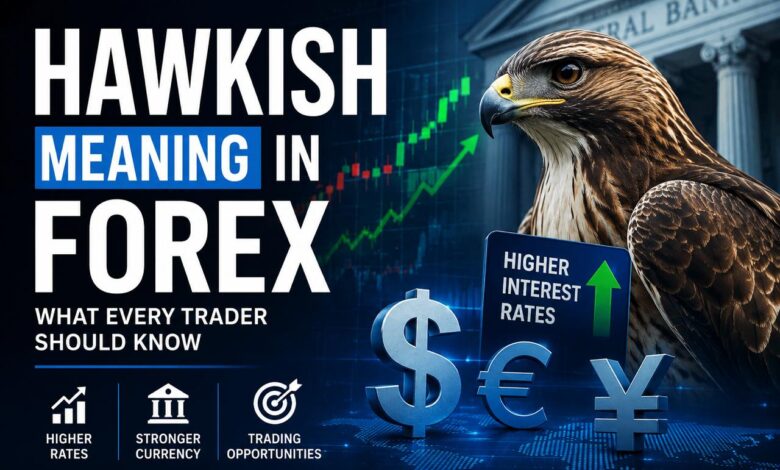
In forex trading, hawkish refers to a central bank or policymaker that is more likely to raise interest rates or keep them high to control inflation.
A hawkish central bank prioritizes reducing inflation, even if doing so slows economic growth.
For example, if the U.S. Federal Reserve announces that inflation remains too high and interest rates may increase further, traders consider the Fed’s stance hawkish.
Why Is a Hawkish Central Bank Important?
Higher interest rates generally make a country’s currency more attractive to investors because they can earn better returns on investments denominated in that currency.
As demand for the currency increases, its value often rises against other currencies.
For example:
- A hawkish Federal Reserve can strengthen the U.S. dollar (USD).
- A hawkish Bank of England can strengthen the British pound (GBP).
- A hawkish European Central Bank can support the euro (EUR).
Characteristics of a Hawkish Central Bank
A central bank is considered hawkish when it:
- Raises interest rates.
- Signals that more rate hikes may come.
- Focuses heavily on fighting inflation.
- Reduces money supply.
- Uses strong language about keeping inflation under control.
Example of Hawkish Policy
Imagine inflation in the United States rises to an uncomfortable level.
The Federal Reserve announces:
“Inflation remains above our target, and additional interest rate increases may be necessary.”
This statement is hawkish because it suggests tighter monetary policy.
As a result:
- The U.S. dollar may strengthen.
- Gold prices may fall because a stronger dollar often puts pressure on gold.
- Stock markets may experience short-term declines as borrowing becomes more expensive.
How Hawkish News Affects Forex Traders
When traders hear hawkish comments from a central bank, they often expect the country’s currency to appreciate.
For example:
- Hawkish Fed → USD may rise.
- Hawkish ECB → EUR may rise.
- Hawkish BoE → GBP may rise.
However, the market also depends on whether the news was already expected. Sometimes a hawkish announcement has little impact because traders had already priced it into the market.
Hawkish vs Dovish
Understanding the difference between hawkish and dovish is essential.
| Hawkish | Dovish |
|---|---|
| Higher interest rates | Lower interest rates |
| Focus on reducing inflation | Focus on supporting economic growth |
| Currency tends to strengthen | Currency tends to weaken |
| Tight monetary policy | Loose monetary policy |
Simply put:
- Hawkish = Higher rates = Stronger currency
- Dovish = Lower rates = Weaker currency
How to Trade Hawkish News
Forex traders often monitor:
- Central bank interest rate decisions.
- Inflation reports (CPI).
- Employment data.
- Central bank speeches.
- Economic projections.
If a central bank becomes more hawkish than expected, traders may look for buying opportunities in that country’s currency.
However, it’s important to wait for market confirmation instead of entering trades solely based on headlines.
Final Thoughts
A hawkish stance in forex means that a central bank is committed to controlling inflation by maintaining or increasing interest rates. Since higher interest rates usually attract foreign investment, hawkish policies often lead to a stronger currency.
Understanding whether a central bank is hawkish or dovish is one of the most important fundamental analysis skills for forex traders. By following central bank announcements and economic data, you can better understand why currencies move and make more informed trading decisions.
Frequently Asked Questions (FAQs)
What does hawkish mean in forex?
Hawkish refers to a central bank that supports higher interest rates to reduce inflation, which often strengthens its currency.
Is hawkish good for the U.S. dollar?
Yes. A hawkish Federal Reserve generally supports a stronger U.S. dollar because higher interest rates attract investors.
What is the opposite of hawkish?
The opposite of hawkish is dovish, which refers to a central bank that favors lower interest rates and economic stimulus.
Should traders buy a currency after hawkish news?
Not always. While hawkish news can strengthen a currency, traders should also consider market expectations, technical analysis, and overall market sentiment before entering a trade.