
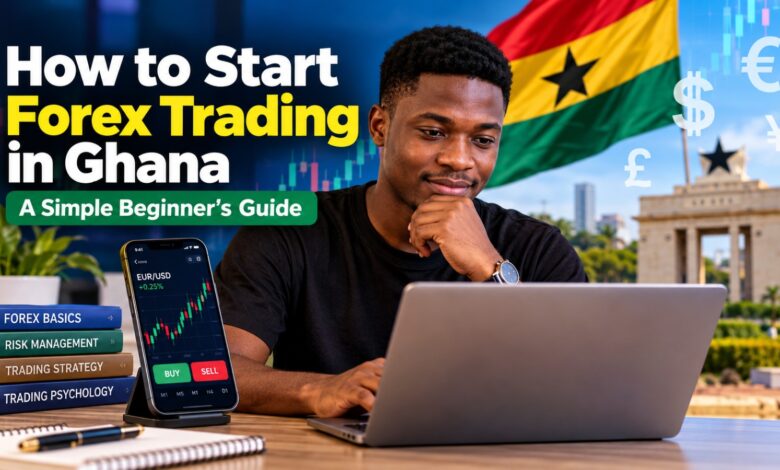
Forex trading is becoming increasingly popular in Ghana. You may have seen people trading currencies on their phones, posting trading results on social media, or talking about pairs such as EUR/USD, GBP/USD and XAU/USD.
If you are completely new to forex, all these terms can make trading look complicated.
The good news is that you do not need to understand everything at once.
In this guide, we will explain how to start forex trading in Ghana from the very beginning, using simple language and practical examples.
If you have never placed a forex trade before, this guide is for you.
What Is Forex Trading?
Let’s start with the simplest explanation.
Forex means foreign exchange.
You have probably already experienced foreign exchange without realizing it.
Imagine you have Ghana cedis (GH₵) and you want to travel to the United States.
You will need to exchange some of your Ghana cedis for US dollars.
The amount of cedis you need to get $1 depends on the exchange rate at that particular time.
Exchange rates change.
Today, one currency may become stronger compared with another. Tomorrow, it may become weaker.
Forex traders try to benefit from these changes in currency prices.
Instead of physically going to a forex bureau and exchanging cash, retail forex traders normally use an online trading platform to speculate on whether one currency will become stronger or weaker against another.
That is forex trading in simple terms.
What Is a Currency Pair?
Currencies are traded in pairs.
You will see names such as:
EUR/USD
GBP/USD
USD/JPY
Don’t worry if these names look confusing.
Each currency has a three-letter code.
For example:
- USD = US Dollar
- EUR = Euro
- GBP = British Pound
- JPY = Japanese Yen
- GHS = Ghana Cedi
Therefore, EUR/USD simply means the Euro compared with the US Dollar.
GBP/USD means the British Pound compared with the US Dollar.
When you trade a currency pair, you are basically making a decision about how one currency will perform compared with the other.
How Do Forex Traders Make Money?
Let’s use a very simple example.
Imagine EUR/USD is trading at:
1.1000
You believe the euro is going to become stronger against the US dollar, so you decide to BUY.
Later, the price increases to:
1.1100
The market has moved in the direction you expected, so your trade could make a profit.
But what happens if you buy and the price falls?
You could lose money.
This is the first thing every beginner needs to understand:
Forex trading can make you money, but it can also make you lose money.
There is no guarantee that the market will move in the direction you predict.
What Do BUY and SELL Mean in Forex?
You will see two important buttons on most trading platforms:
BUY
and
SELL
If you believe the price of a currency pair will rise, you can BUY.
If you believe the price will fall, you can SELL.
For example:
You are watching GBP/USD.
You believe GBP/USD will rise.
You BUY.
If it rises, your trade may become profitable.
If it falls, your trade may lose money.
Now imagine you believe GBP/USD will fall.
You SELL.
If the price falls, your trade may become profitable.
If the price rises, your trade may lose money.
So remember this simple rule:
BUY = You expect the price to go up.
SELL = You expect the price to go down.
Can You Trade Forex in Ghana?
Ghanaians have access to online platforms that advertise forex and other leveraged trading services, but beginners need to pay close attention to regulation.
The Bank of Ghana (BoG) regulates Ghana’s foreign-exchange market, while the Securities and Exchange Commission (SEC Ghana) regulates activities that fall under Ghana’s securities laws.
Do not assume that every forex website or mobile application you find online is licensed to provide its services in Ghana.
This is particularly important because the word forex can refer to different activities.
For example, the Bank of Ghana has authorised certain FX brokers to participate in Ghana’s interbank foreign-exchange market. This is not automatically the same thing as an online retail trading platform where an individual opens an account and trades using MetaTrader.
Before putting money into any trading platform, check who operates it, where the company is regulated and whether it is authorised to provide the service being offered to you.
What Do You Need to Start Forex Trading in Ghana?
You don’t need a special computer or an office.
At a basic level, you will normally need:
- A smartphone, tablet or computer
- Reliable internet connection
- Basic forex education
- A demo trading account
- A trading platform
- A carefully selected trading provider
- Money you can afford to lose when you eventually move to live trading
However, do not start by depositing money.
Start by learning.
That is one of the most important pieces of advice in this guide.
Step 1: Learn the Basics of Forex
Before trading with real money, learn the basic language used in forex.
You don’t need to learn hundreds of terms.
Start with these:
Currency Pair: Two currencies being compared, such as EUR/USD.
Buy: You believe the price will rise.
Sell: You believe the price will fall.
Profit: Money you make when a trade goes in your favour.
Loss: Money you lose when the trade goes against you.
Broker/Trading Provider: The company or service through which you access the market or trading product.
Trading Platform: The software you use to view charts and place trades.
Stop Loss: An instruction designed to close your trade when the market reaches a certain loss level.
Take Profit: An instruction designed to close your trade when the market reaches your chosen profit level.
Lot Size: The size of your trade.
Leverage: A feature that allows you to control a larger position with a smaller amount of money. It can increase both profits and losses.
You will learn more terms as you progress.
Don’t try to memorize everything in one day.
Step 2: Understand What a Forex Broker Does
You normally cannot simply open your phone and trade the global currency market directly.
Retail traders typically access trading products through a broker or another financial-services provider.
Think of the provider as the company giving you access to the trading environment.
This is why choosing one is very important.
There are many online trading companies advertising their services to Africans, including Ghanaians.
But don’t choose a company simply because your favourite trader promotes it.
Before opening an account, investigate the company.
Check things such as:
- Who owns the platform?
- Where is the company based?
- Is it regulated?
- Which regulator supervises it?
- Can you confirm the licence on the regulator’s own website?
- Which legal company will actually hold your account?
- What are the deposit methods?
- What are the withdrawal methods?
- What fees will you pay?
- How does customer support work?
Be especially careful with platforms promising guaranteed profits.
Step 3: Open a Demo Account
This is where your actual practice should begin.
A demo account allows you to practise forex trading without risking your real money.
The money inside the account is virtual.
For example, your demo account might show:
Balance: $1,000
That does not mean someone has given you $1,000.
It is practice money.
You can use it to learn how to:
- Buy
- Sell
- Open trades
- Close trades
- Set a stop loss
- Set a take profit
- Read charts
- Practise your strategy
If you lose the demo money, you haven’t lost real cash.
That makes a demo account very useful for beginners.
Step 4: Learn How to Read a Forex Chart
When you open a trading platform, you will probably see a chart moving up and down.
Don’t panic.
A chart is simply showing you what has happened to the price over time.
If price is generally moving upward, buyers have been pushing the market higher.
If price is generally moving downward, sellers have been pushing the market lower.
One popular type of chart is called a candlestick chart.
You will see candles of different colours.
Each candle shows what happened to the price during a particular period.
For example, one candle could represent:
- 1 minute
- 5 minutes
- 15 minutes
- 1 hour
- 4 hours
- 1 day
You don’t have to understand every candlestick pattern before you start learning.
Initially, simply learn to look at a chart and identify whether price has generally been going up, down or sideways.
Step 5: Understand Stop Loss
A stop loss is extremely important.
Imagine you buy EUR/USD because you believe the price will rise.
But instead of rising, the price starts falling.
How much are you willing to lose before accepting that your idea was wrong?
That is where a stop loss comes in.
You can set your trade to automatically close if price reaches a particular level.
Think of it like saying:
“If the market reaches this point, my idea was wrong. Close the trade.”
Without a stop loss, a beginner may continue watching a losing position become bigger and bigger because they are hoping the market will eventually come back.
Hope is not a risk-management strategy.
Step 6: Understand Take Profit
A take profit works in the opposite direction.
Imagine you buy a currency pair and the market starts moving upward as you expected.
You have already decided where you want to take your profit.
You can set a Take Profit at that level.
When the market reaches it, the position can close automatically.
So:
Stop Loss = helps limit a losing trade.
Take Profit = closes your position at a chosen profitable level.
Both are useful tools for managing trades.
Step 7: Understand Lot Size
Lot size is simply the size of your trade.
This is very important because your position size affects how much money you can gain or lose when the market moves.
You may see sizes such as:
0.01
0.10
1.00
A beginner may think:
“1.00 looks better than 0.01 because I can make more money.”
Yes, a bigger position can make more money when the market goes your way.
But it can also lose money much faster when the market moves against you.
Never choose your lot size simply because you want a bigger profit.
Your position size should be connected to how much of your account you are prepared to risk.
Step 8: Understand Leverage
This is another word that scares beginners, but the basic idea is simple.
Leverage allows you to control a position that is larger than the amount of money in your account.
For example, a broker might offer leverage such as:
1:10
1:50
1:100
1:500
or another ratio.
High leverage may look attractive because it allows a small account to control larger positions.
But there is a problem.
Leverage can make you lose money faster too.
Imagine you have only $100 but trade as though you have a huge account.
A relatively small market movement against you could cause a serious loss.
So don’t think:
High leverage = easy money.
Think:
High leverage = greater potential exposure and therefore greater need for careful risk control.
Step 9: Learn a Simple Trading Strategy
Now you need rules for deciding when to buy and sell.
This is called a trading strategy.
Don’t make it too complicated.
As a beginner, you don’t need ten indicators on your screen.
Your strategy should answer simple questions:
What will I trade?
Maybe EUR/USD.
When will I buy?
Your strategy should give you a clear reason.
When will I sell?
Again, you need a clear reason.
Where will I place my stop loss?
Know where you will accept that your idea was wrong.
Where will I take profit?
Know where you plan to exit if the trade moves in your favour.
How much will I risk?
Decide this before entering the trade.
If you cannot answer these questions, you should probably not take the trade.
Step 10: Practise on Demo
Don’t use your demo account for only two days and immediately move to real money.
Use it to practise.
Suppose you create a simple trading strategy.
Test it repeatedly.
If you take 30 trades, record what happened.
If you take 50 trades, study the results.
Ask yourself:
How many trades won?
How many lost?
How much did I make when I won?
How much did I lose when I was wrong?
Did I follow my rules?
Which mistakes did I repeatedly make?
The purpose of demo trading is not to prove that you can make fake money.
It is to learn how to trade according to a plan.
Step 11: Keep a Trading Journal
A trading journal is simply a record of your trades.
You can use a notebook, spreadsheet or another suitable tool.
For every trade, record:
- What you traded
- Whether you bought or sold
- Why you entered
- Your entry price
- Your stop loss
- Your target
- How much you risked
- Whether you won or lost
- What you learned
You can also take a screenshot of the chart.
Over time, your journal can show you what you are doing correctly and what you need to improve.
Step 12: Start With a Small Live Account
After learning, practising and testing your strategy, you may eventually decide to move to a live account.
This is where real money is involved.
Start carefully.
Do not put all your savings into forex.
Do not use your rent money.
Do not use your school fees.
Do not borrow money to trade.
Do not use money needed for food or emergencies.
Only use money you can genuinely afford to lose.
Why?
Because no matter how good you become, losing trades will happen.
How Much Money Do You Need to Start Forex Trading in Ghana?
There is no single amount that everyone must start with.
Different providers have different minimum deposits and account requirements.
Some beginners may want to start with the equivalent of $50, $100, $200 or more.
But here is something important:
Being allowed to deposit a small amount does not mean that amount can realistically provide you with a full-time income.
For example, imagine you start with $100.
You shouldn’t immediately be asking:
“How can I make $100 every day?”
You are basically asking how to regularly double your money in a single day.
Trying to achieve that would normally require enormous risk.
Instead, your question should be:
“How can I learn to manage this $100 responsibly?”
Your first live account should be more about learning discipline than becoming rich.
Can I Start Forex Trading With GH₵500?
Potentially, depending on the provider, its minimum account requirements and whether that service is appropriate and available to you.
But GH₵500 should not be treated as a machine that will suddenly produce GH₵5,000 every month.
A small account means your potential monetary returns will also generally be small if you are controlling risk responsibly.
This is where many beginners make a mistake.
They have a small account but want very large profits.
To achieve those large profits, they take huge risks.
A few losing trades then wipe out the account.
Don’t focus on getting rich quickly.
Focus on learning.
Which Currency Pair Should a Beginner Trade?
You don’t need to trade everything.
Beginners can start by studying a few major currency pairs such as:
EUR/USD
GBP/USD
USD/JPY
You could even choose just one initially.
Study it.
Watch how it moves.
Learn when it tends to become more active.
Understand how economic news affects it.
You don’t become a better trader because you have 20 charts open.
What About Gold?
You will frequently hear traders talking about XAU/USD.
This represents gold priced against the US dollar.
Gold is extremely popular among retail traders.
But beginners should understand that gold can move quickly.
Fast movement means you may make money quickly if you are correct, but you can also lose money quickly when you are wrong.
Don’t trade gold simply because you see people posting large profits from it.
Understand its behaviour and risk first.
Can Forex Make You Rich?
It is possible to make money from trading, but you should not approach forex as a get-rich-quick scheme.
Social media can make trading look easy.
Someone posts:
+$500 today
Then tomorrow:
+$1,200
Then another screenshot showing a withdrawal.
What you may not see are their losing trades.
You may not know how much money they started with.
You may not know whether the screenshot is genuine.
You may not know how much risk they took.
Never compare your beginning with someone’s social-media highlights.
Be Careful With Forex Scams in Ghana
This is extremely important.
You may encounter someone saying:
“Give me GH₵1,000 and I’ll turn it into GH₵5,000.”
Another person might say:
“Our forex investment gives guaranteed 30% returns every month.”
Someone else may tell you:
“Send your money. Our professional traders will trade it for you. You cannot lose.”
Be very careful.
No one can honestly guarantee that every forex trade will make money.
Before giving money to anyone for trading or investment purposes, investigate the person or company and check whether the activity requires regulatory approval.
Ghana’s Securities and Exchange Commission regularly warns the public about unlicensed investment schemes.
A large social-media following is not a financial licence.
Don’t Blindly Follow Forex Signals
You may find WhatsApp or Telegram groups sending messages such as:
BUY EUR/USD NOW
SELL GOLD NOW
It can be tempting to copy every trade.
But ask yourself:
Why are we buying?
Why are we selling?
How much should I risk?
Where is the trade wrong?
If you cannot answer those questions, you are simply gambling on somebody else’s decision.
Signals should never replace education.
Your goal should be learning how to make and manage your own trading decisions.
What Is Risk Management?
Risk management means controlling how much money you can lose.
This is probably more important than finding the perfect strategy.
Imagine you have $100.
If you risk $50 on one trade and lose, half your account is gone.
One bad decision has caused serious damage.
Instead of asking:
“How much can I make from this trade?”
Train yourself to first ask:
“How much can I lose if I am wrong?”
That one question can completely change the way you trade.
The Biggest Mistakes New Forex Traders Make
Beginners often make the same mistakes:
- Starting with real money before learning
- Trying to become rich quickly
- Using very large lot sizes
- Trading without a stop loss
- Copying random signals
- Using unverified brokers or platforms
- Giving money to fake account managers
- Trading because of social-media hype
- Taking too many trades
- Changing strategies every week
- Borrowing money to trade
- Trying to recover losses immediately
- Using money they cannot afford to lose
Avoiding these mistakes can save you money and frustration.
A Simple Forex Learning Plan for a Complete Beginner in Ghana
If you are starting today, don’t make things complicated.
Follow this order:
Week 1: Learn the Basics
Learn what forex is, currency pairs, BUY, SELL, lot sizes, leverage, stop loss and take profit.
Week 2: Learn Your Trading Platform
Open a demo account and practise buying, selling, setting stops and closing trades.
Week 3: Learn Charts
Understand basic candlesticks, trends and important price areas.
Week 4: Learn Risk Management
Learn how position size and stop-loss distance affect how much money you can lose.
Month 2: Build a Simple Strategy
Choose one or two currency pairs and create clear rules for entering and exiting trades.
Month 3 and Beyond: Practise
Test your strategy on demo.
Keep a journal.
Study your mistakes.
Improve gradually.
Don’t rush to deposit real money because somebody else is making money.
Your journey is yours.
Final Words
If you want to start forex trading in Ghana, remember this:
Don’t start with money. Start with knowledge.
Learn what forex means.
Learn how BUY and SELL work.
Understand lot sizes.
Understand leverage.
Learn how stop losses work.
Open a demo account.
Practise.
Create a simple strategy.
Learn risk management.
Check the regulatory status of any company you are considering.
Then, if you eventually decide to trade with real money, start carefully with money you can afford to lose.
Forex trading is not about pressing BUY and SELL randomly and hoping to become rich.
It is a skill.
And like every skill, it takes time to learn.
Your first goal should therefore not be:
“How much money can I make?”
Your first goal should be:
“Can I understand what I’m doing and protect my money while I learn?”
Once you can answer yes to that question, you are moving in the right direction.
Disclaimer: Forex and leveraged trading involve significant risk and can result in financial loss. This guide is for educational purposes only and is not financial or investment advice. Always verify the current regulatory status of a financial service or trading platform before depositing money.