
7 Risk Checks Before Using an MT5 Expert Advisor in a Prop-Trading Evaluation

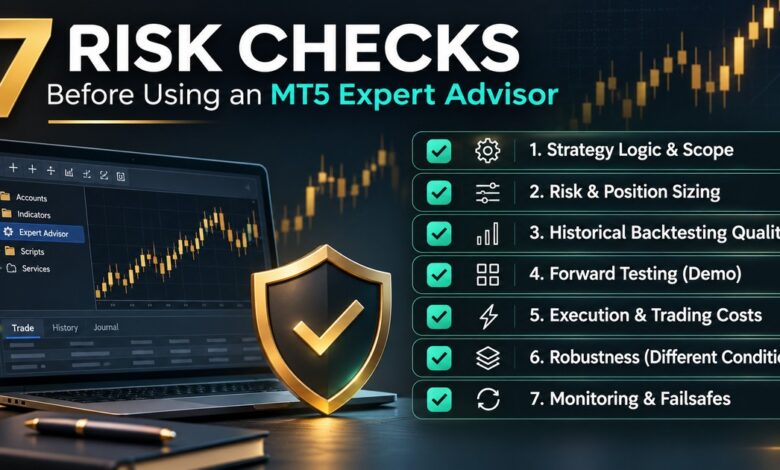
A smooth MetaTrader 5 Strategy Tester equity curve is not proof that an Expert Advisor (EA) can comply with a prop-trading evaluation’s rules. An EA can be profitable in a backtest and still fail an evaluation because of floating drawdown, inconsistent position sizing, execution costs or a disallowed trading session. Before switching on automation, treat the firm’s current rules as engineering requirements and test them explicitly.1. Translate the drawdown rules into calculations
Write down the exact daily-loss and overall-loss formulas. Does the firm measure balance, equity or both? Is the overall limit static or trailing? When does its trading day reset, in which time zone, and how are open profits and losses handled? An EA’s internal “daily loss” setting is useful only if it matches the applicable definition. Create tests for a loss just below the threshold, a floating loss that crosses it, and the exact reset boundary. Do not assume all evaluation programs implement the same rule.2. Size each position from the actual stop distance
A fixed lot size is not a fixed cash risk. Position risk depends on stop distance, tick size, tick value, contract specifications, account currency and trading costs. For XAUUSD especially, broker symbols and contract settings can differ. Use MT5 symbol properties and verify the currency conversion rather than relying on a generic “pip value.” Size against a defined account-level risk budget, round to the broker’s permitted volume step, and reject the trade if it cannot meet the budget. A stop order also does not guarantee the requested fill price during gaps or severe slippage.3. Add all simultaneous exposures
Two independent strategies can both buy gold, or a gold and currency trade may share sensitivity to the same macro event. Check risk across every open position and pending order, not merely per EA. Include correlated exposures and the effect of positions managed manually. The relevant question is whether the account could breach its rules under a plausible combined loss. An account-wide pre-trade gate should reject additional exposure once the configured ceiling is reached.4. Stress-test spreads and execution
Backtests often simplify the costs that matter most around volatility. Re-run representative periods with wider spreads, nonzero commissions, swaps where applicable and conservative slippage assumptions. Inspect order rejections, partial fills, volume constraints and different broker execution modes. Separate signal quality from execution quality: a promising entry signal has little practical value if it requires fills the chosen environment cannot consistently provide.5. Make sessions and news restrictions deterministic
Some evaluation programs restrict high-impact announcements, weekend holding, certain instruments or strategies. Others allow them. Review the latest applicable rules rather than assuming a universal “news ban.” Translate restrictions into a clock-aware schedule with explicit time-zone and daylight-saving handling. Verify that the EA blocks new orders inside prohibited windows and treats missing or stale calendar data conservatively. Test the transition into and out of each blocked interval.6. Plan for terminal failures and restarts
What happens if MT5 disconnects, the VPS restarts, the feed becomes stale or the EA loses track of an order? A safe restart should first reconcile actual positions and orders before making a new decision. Duplicate entry after reconnection can break the entire risk budget. Test crash recovery, duplicate-signal prevention, persistent daily risk counters and clear operator alerts. Where broker-side protection is possible, understand what remains in force when the EA is offline; an on-screen “stop” button cannot protect an account while the terminal is unavailable.7. Demand evidence beyond one attractive backtest
Keep the source data, symbol settings, EA version, parameter file, tester settings and execution assumptions needed to reproduce results. Separate development periods from untouched out-of-sample data and use walk-forward checks to look for overfitting. Review drawdown, trade count, profit factor, average win and loss, losing streaks and exposure—not net profit alone. Then observe the same build in an authorized demo or paper environment. Demo-forward behavior is evidence about implementation, not proof of future profitability.A practical acceptance exercise
Before any evaluation, simulate a widened spread, a floating-loss threshold crossing, a restricted announcement window, a terminal restart and an order rejection. Record the expected behavior, actual behavior and logs for each case. If the system cannot demonstrate the required safe response, the appropriate outcome is “not ready,” regardless of its backtest return.
Educational material only, not investment advice or a claim of independently verified trading performance. Evaluation terms, platform support and EA permissions must be confirmed directly with the relevant provider.
ONE-PAGE READER CHECKLISTIs My MT5 EA Evaluation-Ready?
Mark Pass / Fail / Not Tested and retain a screenshot or log for each control.
- Drawdown definitions: Daily and total limits use the firm’s correct balance/equity basis, time-zone reset, floating P&L and trailing logic. Test a floating breach.
- Per-trade sizing: Stop-distance risk is computed from actual MT5 symbol specifications, account currency and volume step. Trades exceeding the configured limit are rejected.
- Combined exposure: All open and pending orders, strategies, manual trades and correlated instruments are included in the account risk ceiling.
- Execution assumptions: Run spread/commission/slippage sensitivity, plus rejected-order, partial-fill and gap scenarios. No assumed perfect fills.
- Rule-based trading windows: News, sessions, weekend and instrument permissions match the provider’s current terms. Missing calendar or stale clock data blocks prohibited entries.
- Restart and connectivity: Disconnect/reconnect and restart tests reconcile broker positions, preserve risk counters, suppress duplicate orders and raise clear alerts.
- Reproducible evidence: Store EA build, parameters, tester configuration, data provenance, out-of-sample results, drawdown and forward/demo observations.
Acceptance decision: Any required control marked Fail or Not Tested means NOT READY. Re-run after remediation. A clean checklist does not certify profitability or guarantee challenge compliance.
EDITORIAL DISCLOSURE
Prepared by BoltIQ Markets, an MT5 engineering and quantitative research software project. Its proposed simulated evaluation program is currently an interest waitlist, not a live funded-account service. No fee, funded account or payout is offered through that waitlist.
Optional educational tool for readers: https://boltiqmarkets.com/
Company website: https://boltiqmarkets.com